

How it works
fixlock adds a memory to your repo: which lines fix a bug or hold a finished feature, who owns them, and why they exist. Then it checks that memory at five points, from the AI's first edit to the merge button.
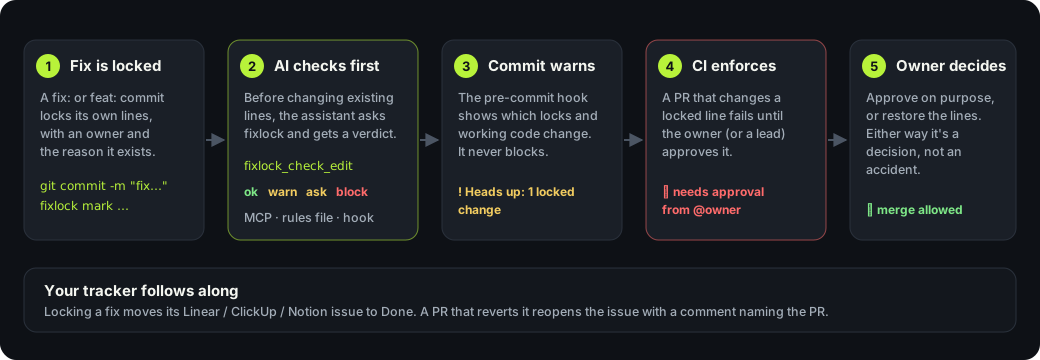
1. A fix is locked
A lock is a few lines of code plus an owner, a reason and, optionally, an issue:
{ "id": "FIX-001", "type": "bug", "title": "SAP date format",
  "file": "src/sap/date.ts", "snippet": ["const p = (n) => …", "return `${d.getFullYear()}-…`;"],
  "owner": "abinandhmj", "reason": "SAP B1 rejects ISO timestamps for DocDate", "issue": "linear:ENG-12" }
Locks live in .fixlock/registry.json, committed with your code, so the whole team (and CI) shares them. They're created:
- automatically: a
fix:orfeat:commit locks the lines it added (post-commit hook). The commit body becomes "why it exists". - for history:
npx fixlock autolock --alllocks past fixes that are still in the code. - by hand:
npx fixlock mark <file> <lines> -m "why"for the few lines that matter most.
A lock matches the structure of its code, not line numbers or exact text. Code can move around, be reformatted or gain comments freely. Only changing what the locked code does (deleting it, flipping a condition, changing a value, reading a different field) counts as a change. A consistent variable rename is reported separately as a rename. Files in languages fixlock can't parse (Markdown, JSON, …) are matched line by line as text. How well this works on real code is measured in the accuracy benchmark.
If the same code appears more than once in a file, the lock remembers how many copies there were, so removing the locked copy isn't hidden by an identical one elsewhere.
2. The AI checks before editing
Before an assistant changes existing lines, it asks fixlock, which answers with a verdict:
| Verdict | When | What the assistant does |
|---|---|---|
ok | Nothing locked or protected is affected, or you own the lock | Goes ahead |
warn | Locked lines are touched but kept, or your policy is warn | Goes ahead and mentions it |
ask | The edit removes or rewrites locked lines (default for bug fixes) | Explains and waits for your yes |
block | Policy is block | Leaves the lines alone and builds around them |
How the assistant asks depends on the tool:
- MCP server (Claude Code, Cursor, Copilot, Codex, Gemini, Windsurf): the assistant calls
fixlock_check_edit. - Rules file (12 assistants):
AGENTS.md,.cursor/rules/fixlock.mdcand the rest tell the assistant to check first, and list the locks. - Pre-edit hook (Claude Code): every edit is checked before it happens, even if the model forgets.
Working code that isn't locked
Nobody locks everything, so a second guard covers the rest. If an edit would delete or rewrite lines that are already committed, written by someone else or by you more than 7 days ago, the verdict is ask. Your own fresh and uncommitted work is never interrupted.
3. The commit warns
The pre-commit hook (npx fixlock install-hook) prints the same findings in the terminal. It never blocks a commit: people can always save their work.
4. CI enforces
npx fixlock check in CI compares the PR with main. If a locked line is gone, the check fails with the lock, the reason, and who must approve. It passes when:
- the lock's owner (or a lead, depending on policy) approves the PR on GitHub, or
- the owner opened the PR themselves, or
- the lines are restored.
This is the one hard stop, and it's what makes the earlier warnings trustworthy: whatever tool wrote the code, a reverted fix can't merge unnoticed.
5. The owner decides
Sometimes the change is right: the fix is no longer needed, or the code was replaced on purpose. The owner approves, then re-locks the new lines or removes the lock (npx fixlock remove FIX-001). The point isn't to freeze code. It's that undoing a fix becomes a decision, not an accident.
What fixlock is not
- Not a replacement for tests. A test proves behaviour; a lock remembers that a specific change mattered and who to ask. They work best together:
mark --test spec.tsrecords the test that guards a fix. - Not a code freeze. Everything stays editable. Only removing locked lines needs a second person.
- Not tied to one AI. The rules, the MCP server and the CI check work the same whatever assistant (or human) wrote the code.